
Lead Routing Tools That Move You From "Fairness" to Growth
The silent killer of profitability rarely involves the number of leads entering the funnel.
The bleeding happens in the chaotic moments immediately after the inquiry arrives.
Teams pour thousands into acquisition only to dump those precious opportunities into a bucket with a massive hole in the bottom. The leak springs from the logic, or the complete lack thereof, used to determine whose hands receive that opportunity.
Most of us operate under a self-imposed definition of "fairness" that unintentionally creates a bottleneck. We worry about making sure everyone gets a plate at the table.
However, looking at the qualitative data from high-producing teams, this traditional definition of fairness might be the primary ceiling on your growth.
That ceiling exists because the infrastructure we rely on was built to organize data, rather than to force conversion.
The standard infrastructure for real estate lead routing
To understand how we fix this, we have to look at the tools that currently form the bedrock of the market. These are the systems we have all grown up with.
Each of the products listed below does its job exceptionally well, and for many teams, they serve as the necessary foundation to manage a database.
Standard routing typically utilizes logic that prioritizes either equality or speed. We usually see two dominant methodologies: Round Robin or First-to-Claim.
Round Robin acts like a playground line where everyone takes a turn regardless of skill.
First-to-Claim functions like a scramble where the fastest finger wins.
While both methods successfully move a lead from the system to an agent, neither method accounts for the probability of that lead turning into a contract.
Popular real estate lead routing tools
| Consideration | Why? | Takeaway |
|---|---|---|
| Follow Up Boss | Best for small to mid-sized teams using round robin and first-to-claim routing, with an open API that connects to nearly every tool. | Use as your “central hub” if you want flexible routing plus deep integrations across your tech stack. |
| LionDesk | Solo agents and small teams benefit from basic drip routing plus a built-in dialer and video email for direct outreach. | Great entry point if you prioritize calling and video follow-up inside one simple platform. |
| Top Producer | Traditional teams leveraging MLS-based routing and long-standing MLS connections for robust market report data. | Choose this if your workflows revolve around MLS data and classic, transaction-focused processes. |
| Wise Agent | Relationship-focused teams rely on calendar and task management to drive checklist and transaction-based execution. | Best fit when your success depends on disciplined task lists and transaction management. |
| Placester | Brokerages can route by group (zip/price), tying lead flow directly to website behaviors and agent subdomains. | Ideal if you want routing tightly connected to how visitors search and behave on your brokerage site. |
| BryteCore | Data-driven teams benefit from behavioral-based routing that tracks the lead lifecycle via engagement triggers. | Use when you want routing and strategy informed by rich behavioral analytics, not just source and price. |
Follow Up Boss (FUB) usually resides at the center of any serious discussion regarding lead routing. It functions as the "iPhone of CRMs"—intuitive and playing nicely with almost every other piece of tech.
Native routing within FUB provides a simple way to get leads to agents. However, as teams mature, team leaders often find the native "round robin" functionality becomes too rigid for scaling.
At that stage, teams layer an additional intelligence engine, such as MaverickRE, on top of FUB.
This allows you to maintain the database your agents love while outsourcing the complex, split-second decision-making to a system designed specifically to handle the math of conversion.
The "fairness" fallacy in traditional routing
Even the most sophisticated math will fail if it solves for the wrong variable.
For years, the industry has optimized for "fairness" rather than profit.
We want a happy team where no one feels left out. But "fairness" becomes a fallacy when it presumes that all agents operate as equivalent variables.
We know from experience that they simply do not.
Consider the "Shark Tank" model used to encourage speed. A $1.2 million dollar lead enters the system.
Agent A (25% conversion rate) is driving. Agent B (2% conversion rate) is staring at his phone.
Agent B grabs the lead instantly. The system optimized for speed, saving perhaps ten seconds, but sacrificed competency.
The statistical probability of that lead closing dropped the moment it landed in Agent B's inbox.
Alternatively, consider the round robin trap. The system assigns a lead to Agent C, who is drowning in 40 active leads he hasn't touched in three days.
The system, oblivious to Agent C's bandwidth, views this purely as "Agent C's turn" and dumps lead #41 onto his pile.
This practice essentially burns money.
We treat leads like playing cards to be shuffled out until the deck is empty, ensuring everyone holds the same number of cards.
Yet, in a world where conversion rates vary wildly, equal distribution inevitably yields unequal outcomes.
Successful teams recognize that true fairness means providing each agent with opportunities commensurate with their demonstrated capability to execute.
Solving the fairness issue through an "intelligence layer"
Recognizing that capability remains unattainable if you depend on gut feelings or inflexible spreadsheet logic. We built MaverickRE because the "fairness" issue appeared to be a data problem.
Math usually resolves data problems more effectively than human intuition.
Our Pro Dispatch system views routing leads through the lens of a meritocracy. Rather than blindly assigning leads, it seeks to match specific opportunities to the best performing agent available in real time.
When a lead enters the system, it processes through a decision tree that replicates the intuition of a seasoned sales manager in milliseconds.
The process begins with Lead Characterization, digesting metadata like price point and location.
Then, it initiates Performance Ranking, comparing historical conversion rates. Which agent closes Zillow leads most effectively? Who excels with luxury buyers?
Finally, Assignment occurs. The agent with the highest conversion rate for that specific lead profile gets the first shot.
This approach flips the incentive paradigm completely.
Success in converting leads results in the system rewarding you with more opportunities.
Conversely, allowing leads to slide through the cracks causes the system to automatically throttle your flow until your metrics improve.
Real capacity management
That requirement to "clear your plate" reveals perhaps the single biggest mechanical flaw in most routing methodologies: the lack of hard limits.
Many platforms allow you to define a capacity for an agent, but it functions more like a gentle recommendation.
MaverickRE implements rigid capacity management, designed to protect your top performers from burning out and prevent low performers from hoarding opportunities.
You define an agent's capacity—let's say, 10 active leads. If Agent X has 10 active conversations, the system stops routing further leads to Agent X.
Period.
For an agent to receive a new lead, they must clear a previous one. They must eliminate a poor quality lead, schedule a meeting, or close a sale to free up a slot.
This creates a "scarcity mindset" that drives tremendous productivity.
Agents stop hoarding leads they "might get to later" and attack their pipelines with urgency because that is the only way to earn the right to pursue future opportunities.
| Consideration | Why? | Takeaway |
|---|---|---|
| Type of limit | Traditional routing uses soft limits—agents get warnings but can keep claiming leads. MaverickRE Pro Dispatch uses hard limits that immediately stop new lead delivery when capacity is full. | Hard capacity limits force focus on existing leads instead of endlessly stacking new ones. |
| Routing logic | Traditional systems ask, “Is it the agent’s turn?” MaverickRE asks, “Does this agent actually have bandwidth to work this lead right now?” | Move from turn-based fairness to bandwidth-based performance for better conversion. |
| Outcome | With traditional routing, agents hoard leads and follow-up suffers. With Pro Dispatch, agents must work leads to clear space before receiving more. | Capacity-enforced routing creates healthier pipelines and stronger follow-up habits. |
| Management effort | Traditional routing requires ISAs or managers to manually monitor behavior and step in. MaverickRE lets system rules automatically manage capacity and flow. | Free leadership from babysitting routing so they can focus on coaching and strategy. |
From volume to productivity
As soon as that scarcity mindset takes hold, you see a shift in the office culture.
Agents compete to execute better rather than simply competing for more volume.
In the old model, agents measure success by inbox size: "I want 50 leads a month." In the new model, the focus narrows to productivity: "I want the 10 leads I can actually handle."
Transparency eliminates the interpersonal conflict that plagues sales teams.
If you have managed a team for more than a week, you have likely had to address the complaint, "I never get the good leads."
Advanced reporting allows you to generate a dashboard displaying the complete history:
Leads Offered vs. Leads Accepted vs. Leads Missed.
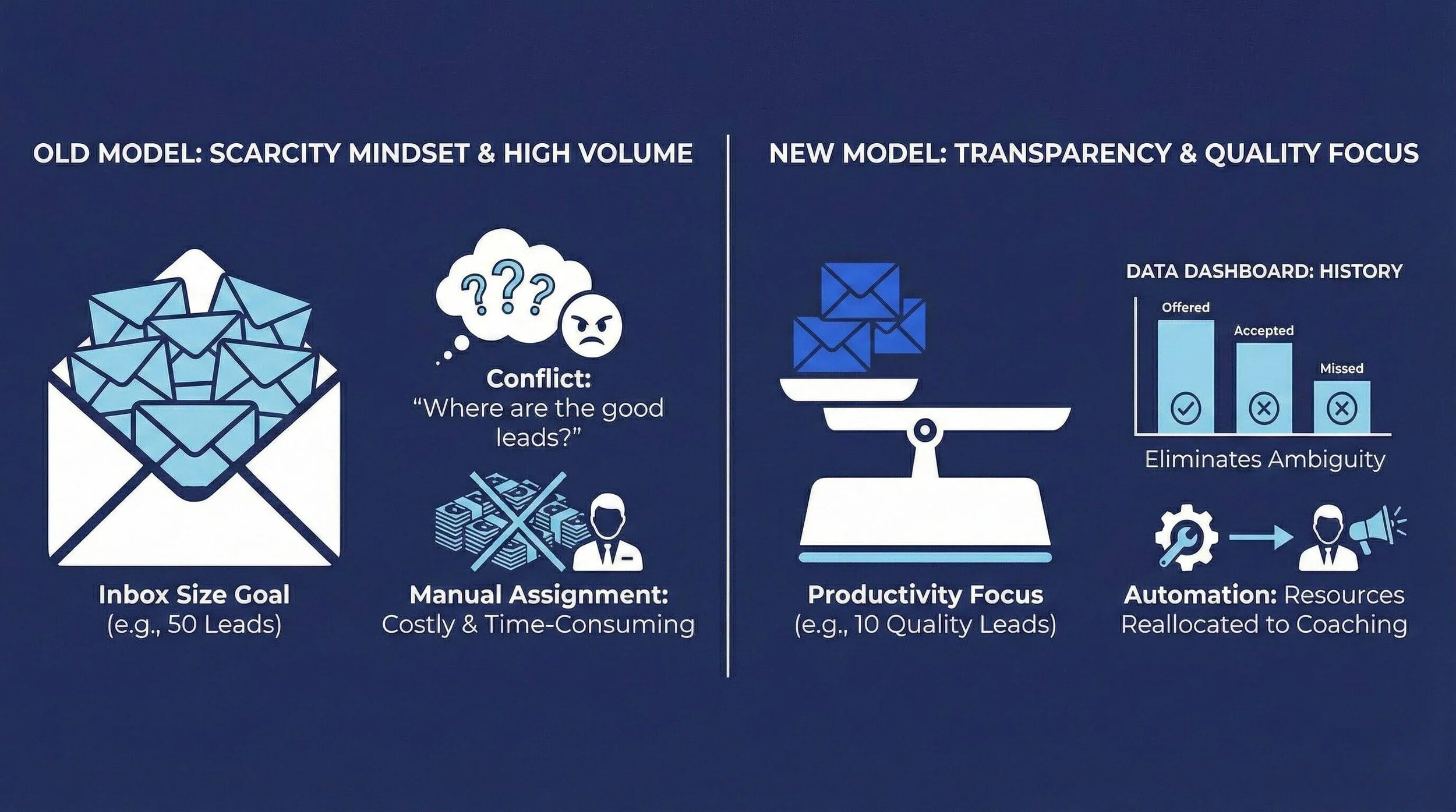
The data removes emotional ambiguity. The conversation changes from "You are not giving me enough" to "You were presented with 15 opportunities; what prevented you from taking advantage of them?"
One of our users shared that prior to implementation, they paid $2,500 per month for a staff member just to manually assign leads.
The automation here effectively replaces the salary of a mid-level manager, allowing those resources to go back into coaching.
What to look for in a routing tool
To capitalize on the savings of automation, you must seek out specific mechanics that force these behavioral changes.
Automated Distribution stands as the bare minimum. Speed remains paramount. If a lead sits in a queue for more than five minutes, qualification rates decline by 400%. The system must respond instantly.
Intelligent Routing (Algorithmic) represents the next level up. You need a system that can distinguish between different lead types. Can it match a $2M Luxury Buyer to the agent specializing in luxury properties? Treating all leads as identical widgets leaves margin on the table.
Integration also plays a critical role. Does the tool sync seamlessly with your CRM (like Pipedrive or Follow Up Boss)? MaverickRE tracks each status change without disrupting your team's workflow.
Lastly, prioritize Rule-Based Assignment. Seek out granular "if/then" logic. If a lead arrives from zip code 90210 and the price point exceeds $2M, then route to the "Luxury Group."
The unseen costs of "agent churn"
If you fail to effectively implement these rule-based assignments, your top performers will ultimately solve the problem themselves: they will leave.
Poor routing practices carry unseen costs, primarily in the form of agent turnover. Top producers want to work where their skills are rewarded.
When they perceive that they compete on equal footing with underperformers who will not answer the phone, they search for new opportunities where their hustle is respected.
By establishing a merit-based routing system, you send a clear message to your top 20 percent: "We see you. We value you. And we will feed you first."
The "opportunity cost" table
| Consideration | Why? | Takeaway |
|---|---|---|
| High volume / low skill | 100 leads at a 1% conversion rate produce just 1 deal and $10,000 GCI, despite a heavy investment in lead volume. | More leads don’t fix low skill; weak conversion turns big budgets into thin margins. |
| Low volume / high skill | 20 leads at a 10% conversion rate result in 2 deals and $20,000 GCI—double the revenue from one-fifth the leads. | High skill multiplies ROI, proving that better agents often beat bigger lead budgets. |
Note that the High Skill agent earned double the revenue with one-fifth of the leads.
An effective routing tool recognizes this discrepancy and ceases to waste marketing dollars on the first agent.
Stop guessing and start closing leads
Ultimately, optimization offers the only real solution to quell that Saturday night anxiety.
If you have read this far, you likely suspect that your current routing setup is hemorrhaging money. The anxiety regarding lead flow is unlikely to dissipate simply because you hired another ISA or bought more leads.
It dissipates when you truly believe in the logic behind the system managing the flow.
Each day you continue to use "equal" routing, you actively decide to send your best leads to your worst converters 50% of the time. You spend money on leads that die in overwhelmed inboxes simply because your routing system lacks the ability to establish rigid capacity limits.
MaverickRE stands as the only platform that combines intelligent, performance-based routing with strict capacity limits and detailed analytical transparency.
We move beyond simply shuttling leads from Point A to Point B; we ensure they route to the agent who is statistically most likely to transform that digital inquiry into a signed contract.
👉 Are you ready to stop the hemorrhaging and start building a system that rewards performance?