
Lead Conversion Tracking in 2026: What is Moving the Needle?
If you have been around some time, you’ve probably seen lead conversion tracking tools evolve from nonexistent, to basic spreadsheets, to sort of prettier spreadsheets that still have not solved the problem.
Which is this:
Every team is losing money because they cannot convert leads, not because they do not have them.
You are spending $50,000 a month on leads and then 60% of them are gone from your CRM—disappearing never to be heard from again.
Understanding the real problem
Here's what the prettier interface did: convinced thousands of teams that they fixed their conversion problem when all they really did was sparkle up their reporting. Measuring conversions? Easy.
Getting a system that reliably enforces conversion behaviors across your team, that's the egg we cannot hatch.
Agents don't log data into the CRM. They forget, are busy, whatever.
You're making million-dollar budget decisions using data that's 40% accurate, maybe, if you're lucky.
If you’re anything like the team leaders we work with, this sentiment should be familiar: "Just forget it! If I'm waiting for an agent to punch in the data, it's not gonna happen!"
The attribution problem is worse. "Three months ago I spent $15,000 on Zillow leads; which closed? Which agents did them? What's our ROI?"
Most teams are still manually building spreadsheets to try answering this.
Then you have your "rules" for follow-up. New leads within 4 hours, nurture leads every 30 days.
Except half your team just…doesn't. By the time you notice, you've lost a quarter's worth of deals.
Lead distribution is a whole other nightmare. Your best $800k listing gets passed to whoever's next in queue, and you're watching your 15% converter fumble what your 35% converter would have closed in a week.
The lead conversion software landscape: What's available
You'd think the software market would be screaming bloody murder to fix this. Nope.
Most software either solves the wrong problems or handles little pieces of what you need.
All-in-one platforms: The kitchen sink approach
These platforms promise everything in one package: IDX websites, CRM automation, lead gen, conversion tracking, everything bundled. One login, one monthly bill, everything "integrated."
Except in the real world? Usually messier than the pitch.
| Consideration | Why? | Takeaway |
|---|---|---|
| Chime | Solo to mid-size teams that rely on automated follow-up and an AI assistant to keep leads consistently nurtured. | Great at automation and AI, but analytics are mostly retrospective, limiting proactive optimization. |
| BoomTown | Teams with a marketing budget who want fully managed PPC and Facebook ads to drive steady lead flow. | Powerful managed marketing, but lead routing is basic and may not support complex team structures. |
| CINC | High-volume teams with ISAs that need managed ads combined with robust automation for follow-up. | Built for scale, but murky ROI tracking makes it difficult to clearly measure true performance. |
| Real Geeks | Value-focused agents who want Facebook retargeting tightly connected with an integrated CRM. | Strong value and retargeting, but missing enforcement tools can weaken accountability and follow-through. |
All-in-one platforms are aimed at lead generation first, conversion tracking second. You want to see what happened with your leads, not how to turn them into clients.
They give you a rear view mirror instead of GPS telling you where to go.
Traditional CRM systems: Powerful but not built for real estate
Once teams reach the point in their growth where they feel ready for a "real" CRM, they start researching tools like HubSpot, Salesforce, Pipedrive, the big players. Customizable, powerful, intimidating.
HubSpot has great reporting. But someone's got to set it up right, keep it maintained, make sure agents actually use it properly.
That's a full-time job most teams aren't ready for.
Salesforce can do anything, it says. You'll spend $50,000 on implementation and need a dedicated admin just for basic changes.
These tools were built for B2B sales—one salesperson managing maybe 50 deals. Your agents have 200+ leads each, transactions taking 6+ months to close.
Different workflow.
Specialized conversion tools: Solving one piece of the puzzle
Frustrated with these platforms, teams sometimes go in the exact opposite direction, seeking more specialized tools instead. Focused on one specific part, doing it well.
Call tracking tools like CallRail and AvidTrak show you which channels generate actual phone calls and which convert. But just to be clear—only showing that phone calls were generated, not the 15 follow-ups over several months that got the deal to close.
Lead capture tools (Spacio, Giosg) are great at top of funnel. Both grab leads that would have slipped away.
After grabbing the lead though, neither tracks what happens next.
Marketing attribution platforms—Zillow Premier Agent, BoldLeads, WhatConverts—focus on how each source performs. Good data to know.
But backward-looking.
What about that lead from this morning who HASN'T been contacted yet? That's the disconnect.
The critical features most teams miss during evaluation
I've heard all of the horror stories of teams shopping for software.
How time and again, they focus on the wrong pieces and repeat the same costly song and dance with little to show for it.
Pretty dashboards get them hyped while they completely overlook the actual systems that make the sales.
Feature 1: automated enforcement, not just measurement
Standard tracking systems say "Hey! Agent Sarah hasn't touched her new lead in 6 hours!" You see it, get annoyed, shoot her a message.
She says "Whoops! Sorry! Promise I'll do it now." Tomorrow she still hasn't called.
Conversion platforms do something different. They ding Sarah with a text and email as soon as that 4-hour timer expires.
If she doesn't respond in 2 hours, you get dinged. If you don't respond, system reassigns that lead to whoever's available.
Lead gets worked. No exceptions.
We call this "nudging." The system enforces compliance in real-time instead of just measuring whether it happened.
Jason Campbell, a team leader using MaverickRE, tracked $100 million in additional sales directly from this feature alone.
| Consideration | Why? | Takeaway |
|---|---|---|
| New lead contact alerts | Immediate alerts can drive a 40–60% improvement by ensuring new leads are contacted quickly, while intent is still high. | Set alerts if a new lead hasn’t been contacted within 4 hours to enforce same-day speed-to-lead. |
| Appointment follow-up | Tight follow-up windows create a 25–35% improvement by keeping appointments accurate and agents accountable. | Trigger an alert if an appointment isn’t updated within 1 hour to enforce real-time status updates. |
| Nurture lead touching | Consistent nurturing can yield a 15–25% improvement by preventing warm leads from going cold over time. | Fire an alert if a nurture lead hasn’t been touched in 14 days to enforce ongoing engagement. |
The platforms that actually impact conversion rates don't have faith in your agents' self-discipline. They enforce compliance.
Automatically.
Feature 2: intelligent lead routing based on performance data
Enforcement handles the first half—ensuring leads get worked. Second half is ensuring you're sending the right leads to the right agents in the first place.
Most teams use round-robin, manual assignment, or whoever "grabs it first." All of these ensure your best leads don't always hit your best converters.
Algorithmic routing tracks how each agent converts by lead type, location, price range, source. When a $600,000 buyer lead hits from Costa Mesa, the system goes straight to whoever has the best conversion rate for $500-700k buyers there.
This kills the politics around lead distribution, gives everyone a fair shot. One team saw rates jump from 8% to 15% just by matching leads to agents better.
Feature 3: true lead source ROI with lifecycle tracking
Better matching only matters if you know which leads are worth matching to begin with. Quick test: What was your ROI on Facebook lead generation last year?
If you can answer that in under a minute, you're probably in the top 5% of teams. Tracking what you paid per lead? Easy.
The hard part is tracking which leads from six or nine months ago are finally converting now.
| Consideration | Why? | Takeaway |
|---|---|---|
| Zillow Q1 | 247 leads → 89 appointments → 31 closings. At a 12.6% close rate, $187,400 in commission on $42/lead delivers 181% ROI. | High intent, strong ROI source. Worth scaling as long as ops can handle the volume and speed-to-lead. |
| Facebook Q1 | 412 leads → 127 appointments → 18 closings. A 4.4% close rate still produces $94,200 in commission at just $18/lead and 127% ROI. | Lower conversion, but cheap leads and solid ROI. Best treated as a long-nurture, high-volume channel. |
| Realtor.com Q1 | 156 leads → 44 appointments → 9 closings. A 5.8% close rate generates $61,300 in commission at $67/lead with 59% ROI. | Mid-range performance with higher lead costs. Optimize scripting and follow-up before increasing budget. |
You need this broken out by month of receipt because these sales cycles run quarters, not weeks. That expensive Zillow contract that looked terrible at 30 days might be your best performer at 180 days.
You'd cancel it before you ever knew.
Feature 4: agent activity intelligence (not just volume metrics)
Knowing where to spend on lead sources is imperative. But even premium leads fail if agents aren't working them right.
Most platforms track volume—calls, texts. Volume without context means nothing.
An agent cranking 100 calls weekly sounds terrific—until you realize they're all 15-second "just checking in" calls booking zero appointments.
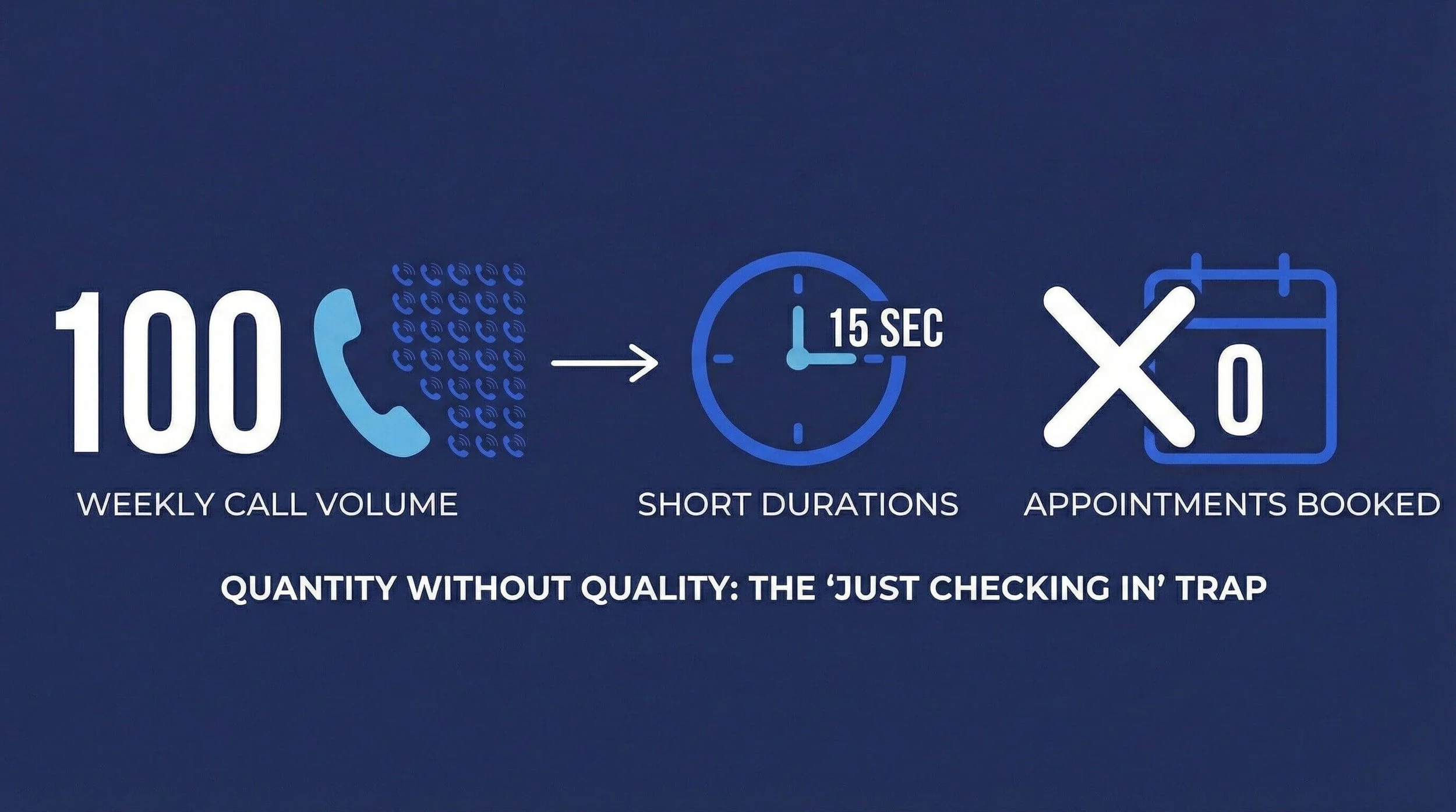
What you really want: contact rate (of attempts, how many connected?), conversation-to-appointment rate (of conversations, how many booked?), appointment show rate (did they show?), text response rate (thoughtful or spam?).
One team found their "top performer" by volume was converting at 3% while their "underperformer" hit 18%. Without that intelligence, they'd have promoted the wrong person.
What to look for when choosing software
Those four features create your foundation: enforcement, smart routing, lifecycle tracking, activity intelligence. When evaluating platforms, asking the right questions matters way more than whatever feature list they claim.
1. Does it enforce process or just measure it?
If their pitch is all about "beautiful dashboards" and "comprehensive reporting?" Drop them.
You need something that stops problems from happening today—not nice graphs of what you missed last month.
Can it auto-alert agents when they need to work more leads? Can it escalate or reassign ignored leads?
Can it make updating the CRM so ridiculously easy agents will actually do it?
One platform shoots agents a text an hour after appointments: "Did you meet with the client?" Agent types back yes or no, picks a pipeline stage via text, types a quick note.
System updates the CRM. That's how low friction needs to be.
2. Can you track true lead source ROI across long sales cycles?
Clean data enables you to track true ROI across real sales cycles. Last I checked, they aren't 30 days long.
Closer to 6-12 months minimum.
If you can't see that February Zillow leads are only at 15% conversion now but, like clockwork, hit 22% by month nine, you'll kill off sources when they're actually profitable—just take time to mature.
3. Does it route leads intelligently or randomly?
You know which sources are profitable, have clean data flowing. Next thing is routing those leads to agents who'll convert them.
Round-robin or manual assignment leaves money on the table. No metaphor: closed deals you would get with better routing.
The MaverickRE approach
All these evaluation criteria point back to the same constant: most platforms fundamentally misunderstand how to track true conversion. Most CRM analytics show you what happened.
Digital rearview mirrors. Handy for monthly reports, less so for running tighter operations.
MaverickRE got built differently—real estate teams working on their own problems for three years.
Automated nudging manages your pipeline 24/7
New leads with zero contacts in four hours trigger alerts. Appointments unupdated for two+ days generate reminders.
Cold nurture leads get flagged and reassigned.
Traditional CRM morning: You log in, notice Agent Mike hasn't touched a three-day-old lead. You shoot him a message—he says he'll deal with it.
Mid-afternoon rolls around, you forget. Lead goes cold.
Enforcement morning: System texted Mike at 24 hours, at 48. At 72 hours it pings you.
You reassign with one button push. Gets worked within the hour.
Algorithmic routing
With MaverickRE we use algorithmic routing. That $750,000 buyer lead comes in.
System identifies qualified agents, rates by conversion rate, presents to your top performer.
The lead source report
The Lead Source Report tracks conversion rate across each source by month, quarterly, annually. That Zillow contract looks like a fortune at 30 days.
At 180 days, turns out to be your top performer. Leads just take longer to mature, close at better price points.
| Consideration | Why? | Takeaway |
|---|---|---|
| Reporting | Traditional CRMs only show what happened yesterday. MaverickRE surfaces issues in real time so you can prevent problems today. | Shift from rear-view reports to proactive, daily decision-making. |
| Data quality | Traditional systems depend on agent discipline. MaverickRE uses automated updates so key fields stay accurate without nagging. | Remove “please update your CRM” conversations with auto-enforced data quality. |
| Lead distribution | Manual or round-robin routing ignores performance. MaverickRE uses algorithmic routing to favor higher-converting agents and teams. | Let the system route leads to where they’re statistically most likely to convert. |
| Follow-up | Traditional CRMs hope agents remember tasks. MaverickRE adds automated nudging so no hot lead slips through the cracks. | Replace memory-based follow-up with structured, automated enforcement. |
| Source ROI | Most CRMs give a current snapshot. MaverickRE tracks the full lifecycle, from first contact to repeat and referral business. | Understand true ROI over time instead of judging channels on day-one results. |
MaverickRE teams are working 16× more appointments per agent, with 120% better conversion rates. Same agents, different systems—catching more leads before they slip through cracks.
Ready to stop letting leads slip away? Here's what to do next
Those numbers come from real teams dealing with your issues. Every day you run without enforcement is a day you're bleeding opportunities.
👉 MaverickRE tracks your pipeline to make sure everything happens on time. The money comes from enforcing that the follow-up actually happens.