
Get Clients in 2026: A Guide to Building a Thriving Real Estate Business
Dec 19
Written By Aaron Kiwi Franklin
Getting clients keeps your real estate business alive. Simple as that.
But what kills me about most agents today is this: They dump thousands (five figures sometimes) into Zillow, Facebook ads, cold calling services that promise the moon.
Then they wonder where all the clients went.
You think the problem is lead generation.
But conversion is where agents actually fail.
As proof, you likely have leads sitting in your database right now. Collecting dust.
To illustrate, let me tell you about a $600,000 story that makes this clear.
Dead databases: The real problem
Barry Jenkins had a problem. 700 cold leads in his database.
Just sitting there for months.
His team finally got an ISA to call through all of them. Guess what they found?
70 people had already bought homes. With other agents.
$600,000 in commissions. Gone. From leads they had already paid for.
These were leads that said yes to someone else while Barry was ignoring them. The money was there, the clients were ready, but nobody followed up.
Over half of all conversions happen after six months of follow-up. Six months.
Yet most agents quit after 30 days. You give up right when the odds start working in your favor.
Like leaving a poker table right before your hand comes in.
| Follow-Up Timeframe | Conversion Rate | Agent Drop-Off Rate |
|---|---|---|
| 0-30 days | 18% | 15% |
| 31-90 days | 22% | 45% |
| 91-180 days | 28% | 72% |
| 6+ months | 32% | 88% |
Look at those numbers. Really look at them.
The longer you stay in touch, the better your conversion rate gets. 32% after six months compared to 18% in the first month.
But 88% of agents drop off before they hit that sweet spot.
They quit when they should double down. Classic mistake.
Digital strategies that actually work
You need to be visible where clients are looking.
When someone searches for help buying or selling in 2026, your name better come up first. And I mean creating content that actually helps people. That makes them trust you.
And you can forget posting pretty pictures of houses (God knows we have enough of those already, and it’s really not a strategy).
Think about it from their perspective. They are scared, confused, about to make the biggest financial decision of their lives.
They want answers, period. Your smiling headshot next to a "Just Sold" sign does nothing for them.
1. Create a professional website that converts
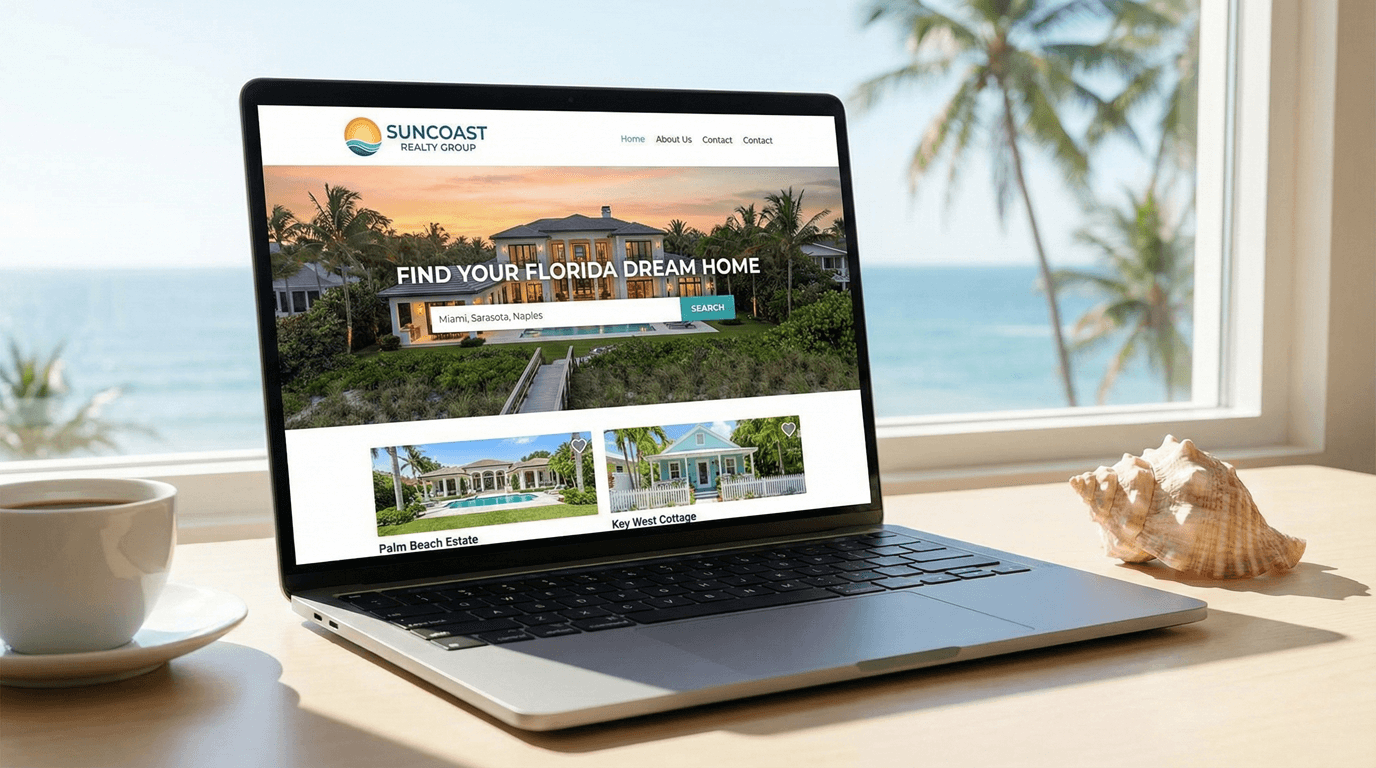
Your website has to do two things.
Capture contact information.
Nurture those leads without you lifting a finger.
Just two things. Yet most agent websites do neither.
Minimum requirements: local market reports, home value estimates (both in exchange for emails), neighborhood guides, video tours, market updates. These are mandatory.
You need all of these.
Make your content valuable enough that people want to hand over their email. A "First-Time Buyer Guide" works.
So does a "Seller Pricing Strategy Report". Whatever solves a problem they have today.
2. Leverage social media to build your brand
Instagram. TikTok. LinkedIn. YouTube.
Pick your poison. The strategy stays the same: give value before you ask for anything.
Yet most agents still get it backwards. They post listing photos with sunset filters asking "Who wants to buy this beauty?" when they have zero followers.
Answer the questions your clients are already asking.
How much home can I afford?
What is my house worth right now?
Should I buy now or wait?
Most agents never touch these questions publicly. They are too busy posting flower filter photos and inspirational quotes.
Be different.
And whatever platform you go with, don’t forget to leverage video.
Video beats photos and text every single time. Even a quick smartphone video about market updates builds more trust than a professionally designed ad that cost you three grand.
People want authenticity instead of production value.
| Platform | Best Content Type | Posting Frequency | Lead Quality |
|---|---|---|---|
| Stories + Reels | Daily | High | |
| TikTok | Educational shorts | 3-5x/week | Medium-High |
| Market insights | 2-3x/week | Very High | |
| YouTube | Long-form guides | 1x/week | Highest |
| Community events | 3x/week | Medium |
Facebook has a Housing category for ads. Use it.
You can target specific neighborhoods, price ranges, buyer types. Combine that with a good lead magnet and you will get qualified leads for way less than Zillow charges.
3. Master search engine optimization (SEO)
Someone types "agent near me" or "homes for sale in [your neighborhood]" into Google.
You want to be at the top. Page two might as well be page 200.
Nobody clicks to page two because it is a graveyard out there.
Write blog posts with local keywords. Claim your Google Business Profile.
Get past clients to leave reviews. Make landing pages for every single neighborhood you work.
SEO is slow. Painfully slow sometimes.
You will write 20 blog posts and rank for nothing. But these leads are free.
Unlike paid ads where you pay every single time someone clicks, organic traffic costs nothing once you rank.
4. Build email drip campaigns that nurture
Most agents collect an email and then... nothing.
A total waste.
Set up automated campaigns like welcome series and market updates based on what they are actually searching for instead of generic neighborhood news nobody cares about. Include property alerts for new listings that match their criteria.
"Just checking in" emails go straight to trash. Every single time.
But emails that solve problems get opened. The entire difference right there.
Traditional methods still generate serious business
Digital matters. Of course it does.
But face-to-face relationships matter more. I spent years trying to build a business purely online.
Guess what happened. It does work for real estate.
You need both.
Old-school prospecting methods work better than online strategies sometimes. Yet most agents just quit before they see results.
They do it for two weeks, get discouraged, decide it does work, and go back to buying Facebook ads.
1. Network like your business depends on it
Your sphere of influence is gold. Pure gold.
This means friends. Family.
Former coworkers. People you actually know.
Start with your contact list. Email, phone, social media, everything.
Tell everyone you are a realtor. Then ask: "Who do you know thinking about buying or selling a home this year?"
Ask directly. Most agents dance around it because they are scared of being pushy.
People want to help you. They just need to know what you do.
| Sphere Contact Type | Conversion Potential | Referral Rate | Follow-Up Frequency |
|---|---|---|---|
| Close friends/family | Very High | 35-50% | Monthly |
| Former colleagues | High | 20-30% | Quarterly |
| Social connections | Medium | 10-15% | Bi-annually |
| Service providers | Medium | 15-25% | Quarterly |
| Vendors you use | Low-Medium | 5-10% | Annually |
Go to community groups. Show up at local events.
Become the person everyone thinks of for real estate in your area. But build actual relationships over time instead of handing out business cards at every opportunity.
Try this: ask your sphere for advice. "I am trying to get better at helping first-time buyers. What do you think matters most to them?"
Opens up conversations without being salesy.
2. Host open houses to meet neighbors
Open houses sell more than the house you are showing. You meet buyers and sellers from the neighborhood.
Most people who show up are neighbors checking out what homes are selling for. Those are your future listings.
Get contact info from everyone. Offer neighbors free home value reports.
Ask if they know anyone planning to move. Follow up the next day.
You might sell that house to someone who walks through, but you will probably land three clients from neighbors who were curious.
3. Door-knock and cold call
Yeah, I know. Nobody wants to hear this.
But it works. Have a reason to be there though.
"There is an open house coming up this weekend." "I am offering free home value reports for the neighborhood." "Know anyone thinking about moving?"
Cold calling takes volume and you need thick skin. Rejections pile up fast.
But make 50-100 calls a day and you will find clients other agents miss. Most people make ten calls, get discouraged, then convince themselves it does work.
| Prospecting Method | Contacts/Hour | Conversion Rate | Time to Close | Cost |
|---|---|---|---|---|
| Door-knocking | 15-20 | 0.5-1% | 3-6 months | Low |
| Cold calling | 25-40 | 0.3-0.8% | 4-8 months | Very Low |
| Networking events | 10-15 | 2-5% | 2-5 months | Medium |
| Social media DMs | 30-50 | 0.2-0.5% | 6-12 months | Low |
These work in 2026 because nobody else wants to do them. Everyone is buying Facebook ads.
You can build real relationships while they are clicking buttons.
4. Farm a specific geographic area
Pick one neighborhood. One zip code.
Become the dominant agent there. Mail postcards monthly.
Door-knock every quarter. Sponsor local events.
Show up consistently.
Takes 6-12 months to see anything happen. Most agents give up around month four when results are still zero.
But push through and you will own that market eventually.
Creating referral relationships
Creating a market of customers means creating relationships. The top real estate agents continually communicate with their past clients long after they have closed a deal with them.
They can also create referrals from these clients.
Use past customers like gold
Most agents celebrate closing by popping a bottle of champagne and then forget about the customer. They are wrong.
These people trusted you, they saw you manage pressure, and they know you do a good job.
Do not stop there. Continue to nurture your past customers.

Send them a card on the anniversary of when they moved into their new home. Send them an update on the current status of the housing market around their property every year.
Send them a personalized gift during the holidays.
Check in with your past customers 4 times a year, send them something useful. A small gift 3-4 months after closing is a good idea.
Random timing usually generates the greatest interest. Sending something during the holidays, when all agents are sending holiday cards, makes you blend in.
Sending something randomly like Tuesday in March, makes you stand out.
Utilize social proof via reviews
Ask your past clients to leave a Google Review after you have closed. Ask them to post a review of their experience with you on their social media channels.
If they are willing, ask them for a video testimonial. Ask them to refer their friends and family to you.
Send them a direct link to make it easy for them. Provide them with a template they can use to edit the review.
Make it easy for them.
| Review Platform | SEO Impact | Trust Value of Client | Time to Get | Usage Priority |
|---|---|---|---|---|
| Very High | Very High | 2-3 days | #1 | |
| Zillow | Medium | High | 1-2 weeks | #2 |
| Realtor.com | Medium | Medium | 1-2 weeks | #3 |
| Low | High | 1-2 days | #4 | |
| Yelp | Low | Medium | 3-5 days | #5 |
Place reviews wherever you put information. On your website, on your social media pages, and on all of your marketing materials.
The fact that you have helped other people gives you credibility, which will help attract potential customers to you much quicker than if you did not have reviews.
Identify Your Market
Reviews mean more when they are coming from the same type of customers you are targeting. Stop being everything to everybody. Choose one type of customer, or one type of property, and be the go-to person for that customer or property.
Select a Niche With Care
Consider first time buyers. Luxury homes. Investment homes. Homes in a specific neighborhood. People relocating to a new city. Senior citizens moving to smaller homes. Select a niche.
Your marketing efforts will be easier and more successful. In addition, the best niches will have a lot of demand, large commission checks, and you will enjoy working with this clientele. You need all three.
Become the Go-To Person in Your Niche
Provide content for your niche. Find groups that your customers belong to and join them. Attend the events that your customers attend. Ask your customers to provide testimonials for you.
When you are identified as the agent that specializes in helping first-time buyers purchase homes using FHA financing, referrals will come to you with little or no effort.
| Type of Niche | Level of Competition | Average Commissions Per Transaction | Customer Loyalty | Cost of Marketing |
|---|---|---|---|---|
| First Time Buyers | High | $6,000-$10,000 | Very High | Medium |
| Luxury (homes over $1 Million) | Medium | $20,000-$50,000 | Medium | High |
| Investment Properties | Low | $8,000-$15,000 | Very High | Low |
| Senior Downsizing | Low-Medium | $10,000-$20,000 | High | Medium |
| New Construction | Medium | $8,000-$12,000 | Low | Medium |
The most common mistake made by agents
Recruiting the correct leads is only half of the battle. Many agents have enough qualified leads to generate a multi-million dollar business right now.
However, they simply fail to convert them.
Establish automatic follow-up to ensure nothing falls between the cracks. Active buyers are contacted twice a week.
Short-term nurtures are contacted twice a month. Long-term leads are contacted once a month.
Track everything. This sounds simple.
However, most agents cannot maintain this level of activity without having systems in place to force them to.
Mike Schumm conducted an experiment with his Wisconsin-based team of real estate agents. Each agent had 100-300 leads.
While the conversion ratio was fine, it was nothing spectacular. Mike decided to limit the number of leads to 100.
The conversion ratio increased. Then he reduced it again to 75.
The conversion ratio increased even further. Ultimately, Mike limited each agent lead volume to 25.
The agents were extremely productive.
When agents have too many leads, they tend to cherry-pick. Limit the volume of leads and they will actually work the ones they have.
If you have multiple agents, assign the leads to the agent who has the highest conversion ratio based on the lead source, location, and price point. Smart routing can increase your conversion ratios by a significant margin.
Tracking the right metrics
Most agents track leads, phone calls, and open houses. These are wrong metrics.
Those are activity rather than result metrics. However, contact-to-appointment, appointment-to-contract, and contract-to-close are important metrics.
| Performance Metric | Top 20% Agents | Average Agents | Bottom 50% |
|---|---|---|---|
| Contact-to-appointment | 12-18% | 6-10% | 2-5% |
| Appointment-to-contract | 35-50% | 20-30% | 10-18% |
| Attempts to Follow Up Before Giving Up | > 15 | 5-8 | 2-3 |
| Response Time to Lead Activity | < 5 Minutes | 1-4 Hours | 4+ Hours |
| Number of Contacts with Sphere Monthly | > 50 | 20-30 | 0-10 |
By monitoring your conversion ratios, you can identify where the leads are disappearing. Colton Whitney states, "You cannot run away from the numbers. If you are doing your job, you will stand out."
Uncomfortable, but that is how you improve.
Combining everything you have learned
Once you determine where you are losing leads, develop habits that eliminate the loss of leads. Use a combination of strategies.
A 90-day plan works best.
Month 1: setting the foundation
Create a website with lead magnets. Claim and complete your Google Business Profile.
Contact your entire sphere of influence. Select a geographic farming area and create basic social media profiles.
Month 2: creating content and reaching out to people
Develop and implement your first email drip campaigns. Develop valuable content for social media 3-5 times a week.
Host your first open house and cold-call or door knock 3 times a week.
Month 3: scaling and automating
Launch paid social ads. Implement systematic follow-up for all leads.
Monitor your conversion metrics and continue to focus on what works.
Many agents attempt every strategy once, become discouraged, and quit. However, give each strategy 90 days of effort at least.
When technology provides the difference maker
Using manual tracking methods works until they do not. When you are managing 100+ leads from multiple sources, you need systems.
Technology provides insight into where your business is breaking down. Where are leads dying, versus total leads?
Jason Campbell’s team of agents increased their sales by $100 million after implementing better systems. "We have found all the areas where we were losing leads. There is no way to hide from the data. If you are doing your job, you will be noticed."
| Technology Investment | Hours Saved/Week | Improvement in Conversions | ROI Timeline | Best For |
|---|---|---|---|---|
| Automated CRM | 8-12 hours | 15-25% | 3-6 Months | All Agents |
| Lead Routing System | 3-5 hours | 20-35% | 2-4 Months | Multiple Agents |
| AI Call Coaching | 6-10 hours | 10-20% | 2-3 Months | Multiple Agents |
| Marketing Automation | 5-8 hours | 8-15% | 4-6 Months | All Agents |
When you see who is following up on leads, who is converting, and who is allowing leads to die, you can solve problems before they cost you hundreds of thousands of dollars. Ask Barry Jenkins about the $600,000 lesson he learned.
Stopping lost leads
Recruiting clients in 2026 requires converting the leads you currently have instead of finding new ones. Tired of watching millions of dollars evaporate due to lost leads?
Systems will stop that.
MaverickRE maximizes your existing database with smarter lead routing, automatic follow-up that actually occurs, AI-powered call coaching, and tracking your performance against top teams versus industry averages. It converts hours of spreadsheet madness into 15 minutes of clarity.
👉 Stop Chasing. Start Converting.
Aaron, commonly known as Kiwi, earned his nickname due to his origins in New Zealand, where he originally hails from since 1994. He joined Ylopo in 2016 as one of the early hires and works directly under the co-founders, Howard Tager and Juefung Ge.
Kiwi holds a degree in Computer Science and a master's in Internet Marketing from USF. Prior to joining Ylopo, he successfully managed an SEO and digital marketing agency that exclusively catered to plastic surgeons.
Currently residing in Las Vegas, Kiwi enjoys a fulfilling life with his beautiful wife, Jenny. Their pride and joy is their 13-year-old son, Stirling.
Previous\ \ Previous\ Appointment Management in Crisis: Dealing with your Funnel’s Black Hole Next\ \ Next\ \ Knowing Your Worth and Auditing Your Lead Funnel